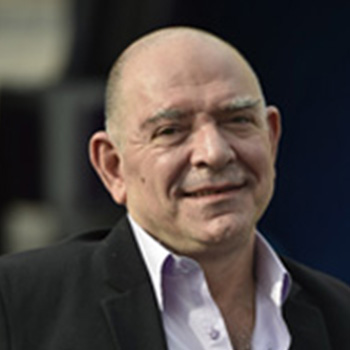
Lebanese publisher, filmmaker, researcher, and writer Lokman Slim was assassinated on the evening of 3 February 2021. While returning from a visit to a friend in the town of Niha, South Lebanon, he was kidnapped, approximately one kilometer from a United Nations Interim Force in Lebanon (UNIFIL) position. His body was found the following morning inside his car in Adoussiyyeh, around 40 km away. According to the forensic report, Slim was killed with a silenced weapon, struck by six bullets - one to the back and the others to the head.
The police investigation has been conducted under the supervision of the appellate public prosecutor of South Lebanon, Judge Rahif Ramadan, as the crime fell within his territorial jurisdiction. Once the police report had been submitted, the case was sent to the First Investigating Judge is Saida, following the territorial jurisdiction. After a sustained pressure from the Slim’s family and further to the request of the Attorney General Judge Ghassan Oueidat, the Court of Cassation issued a decision in June 2021 transferring the case from Saida to Beirut, where the file was assigned to the Chief Investigation Judge Charbel Abou Samra. Judge Abou Samra retired in November 2023 and was succeeded in December 2023 by Judge Bilal Halawi, who assumed responsibility for the file. In December 2024, Judge Halawi issued a decision to shelve the investigation pending the emergence of new evidence, which effectively freezed the proceedings.
Judge Halawi’s decision coincided with a legal challenge filed in November 2024 before the Court of Cassation by the family’s lawyers, Moussa Khoury and Diala Chehadeh, on the grounds of legitimate suspicion. In March 2025, the Court of Cassation ruled in favor of reopening the case. In April 2025, Judge Roula Sfeir was designated to continue the investigation into the circumstances of Lokman Slim’s assassination.
Since founding Dar Al-Jadeed publishing house in the late 1980s, Lokman Slim pursued a rigorous intellectual project grounded in critical inquiry and sustained confrontation with dominant narratives. Through publishing and republication, he returned to circulation bodies of thought that interrogated modernity and the social, religious, and political transformations of Lebanon and its wider region.
Slim identified the preservation of civil war memory not only as a necessity for knowledge production, but also as both a political and civic one. Together with his wife, Monika Borgmann, he founded UMAM Documentation and Research in 2005 as a permanent institutional framework dedicated to archiving, documentation, and critical engagement with political violence.
During this period, Slim also articulated a sovereign and inclusive Lebanese political discourse rooted in the rule of law. He criticized the general amnesty law, denounced the monopolization of state institutions by the Shia duo - Amal and Hezbollah - and consistently opposed Hezbollah’s refusal to place its weapons under Lebanese state authority. In 2005, he supported the Cedar Revolution that led to the withdrawal of the Syrian army from Lebanon and publicly opposed Hezbollah’s unilateral control over decisions of war and peace, which culminated in the July 2006 war.
When Hezbollah intervened militarily in Syria in 2011 in support of the Assad regime, Slim - alongside political and cultural figures from across Lebanon’s sectarian spectrum - publicly denounced the intervention. He argued that it exposed the organic link between Hezbollah and Iran’s system of wilayat al-faqih.
This period marked the launch of sustained defamation campaigns against Shia opponents of Hezbollah, among whom Slim - known for his clarity of expression and insistence on public accountability- was one of the most visible. The descent of the Syrian uprising into civil war, Hezbollah’s transformation into a regional military actor, its near-total control over key administrative levers of the Lebanese state, growing unease within the Shia community as casualties mounted in Syria, and the eruption of nationwide protests in October 2019 demanding political reform all converged to raise the stakes of Slim’s work.
On 12 December 2019, Lokman Slim received direct death threats. A forum believed by his opponents to host his presence was attacked; a group of men wanted to storm the garden of his family home in Haret Hreik - a neighborhood he refused to leave despite escalating danger; and the following morning, paper posters were found on the garden walls, one bearing the message: “Glory to the silencer.”
Slim addressed a written statement to the Lebanese state requesting protection, directly accusing the Amal Movement and Hezbollah of orchestrating the attacks and holding them responsible for any harm that might befall him, his family, or his home. Threats continued to escalate, reaching their peak in the final two months preceding his assassination.
Two weeks before his killing, Slim appeared on Al-Hadath television, presenting a documented analysis asserting that ammonium nitrate stored at the Port of Beirut - whose ignition caused the catastrophic explosion of 4 August 2020 - was being periodically transferred to Syria and used in the manufacture of barrel bombs.
Slim’s assassination coincided with a broader regional pattern of targeted killings of Shia activists opposing Iranian influence, particularly in Iraq, most notably the assassination of Hisham Al-Hashimi. This parallel situates crime within a transnational pattern of selective political violence directed at figures engaged in exposure, documentation, and critique of armed, ideologically anchored power.
The sustained legal struggle pursued by Lokman Slim’s family unfolded in two distinct phases. The first culminated in December 2024 with the decision to shelve the case, effectively narrowing the space available to a family that had exhausted domestic and international avenues to compel Lebanese authorities to identify the perpetrators.
A second phase emerged in the wake of two major regional developments. The first was Israel’s military response to the “support front” declared by Hezbollah following Hamas’s 7 October 2023 attack - a campaign that targeted Hezbollah’s leadership and infrastructure and significantly weakened the organization. The second was the collapse of the Assad regime on 8 December 2024 and the assumption of power by Ahmad Al-Sharaa in Syria, disrupting Iran’s supply lines and its capacity to sustain Hezbollah’s dominance over Lebanon’s internal political field. A new political configuration takes shape in Lebanon: a president is elected in January 2025, a new government is formed in February 2025, and within it the minister of justice, Adel Nassar, takes key measures concerning political assassinations, including the reopening of the investigation into the assassination of Lokman Slim.
The assassination of Lokman Slim, followed by prolonged obstruction, deferral, and suspension of judicial proceedings, exemplifies a condition of hollow sovereignty: a state whose institutional architecture remains formally intact, yet whose capacity to protect those engaged in exposure and to enforce accountability for political murder has been hollowed out from within. The persistence of impunity in this case is structural rather than accidental. It functions as a disciplining mechanism, signaling the risks of knowledge production, documentation, and dissent in a political order where exposure itself becomes a punishable act.